Operation
Google Cloud Landing Zone

Cloud adoption is becoming standard practice for businesses today, but migrating workloads to Google Cloud can present a major challenge for newcomers. This is because GCP offers numerous infrastructure-, platform- and software-based services. So how does an IT manager organise this diverse range of resources to meet business requirements whilst maintaining control, security and compliance? With a Google Cloud Landing Zone!
What is a Google Cloud Landing Zone?
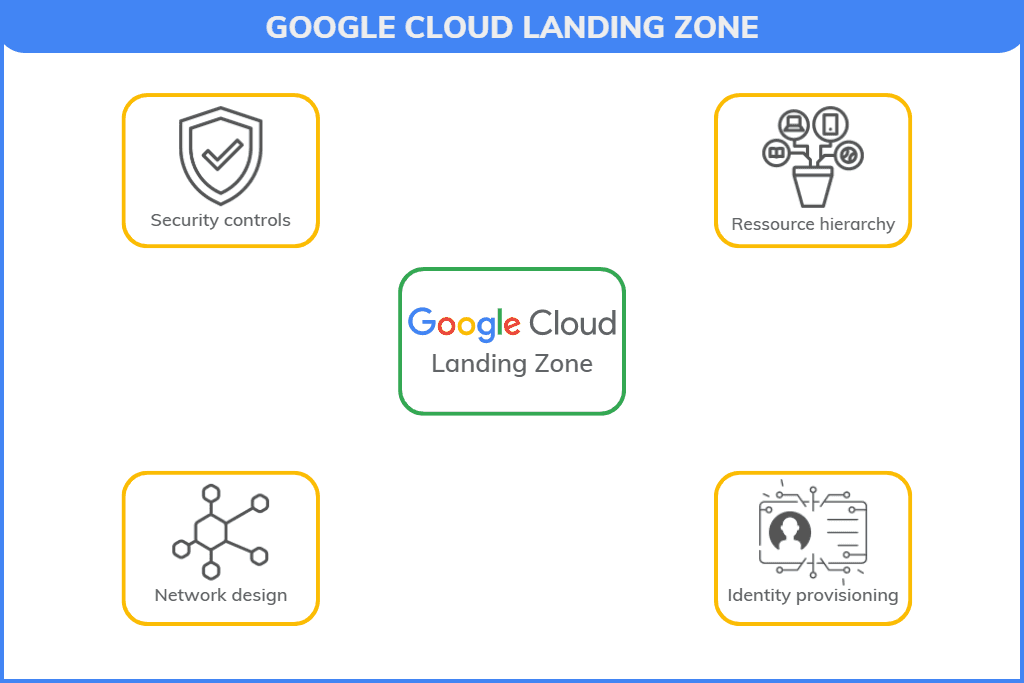
A Google Cloud Landing Zone is simply a foundational blueprint for cloud adoption in GCP. This framework establishes a configuration that helps your organisation use GCP services to meet your business needs. This includes network configurations, defining the resource hierarchy, security and identity management. Because different organisations have different needs, there is no one-size-fits-all design for a landing zone. Each business must develop one that suits its organisational structure, policies, compliance requirements, etc.
The initial version of a Google Cloud Landing Zone is rarely the final one. As you innovate and adopt more cloud-based workloads, it grows dynamically with your cloud environment. It is strongly recommended that a landing zone be a prerequisite before deploying enterprise workloads in a cloud environment, and here is why.
Why do you need a Google Cloud Landing Zone?
As a business shifting its operations to the cloud, a landing zone enables you to deploy, scale and use Google Cloud services more efficiently and securely. It also standardises your cloud environment by providing a foundation for organising your resources, managing your policies, controlling access to your cloud resources, and more. A Google Cloud Landing Zone is essential for your organisation in order to:
Avoid insecure states during cloud adoption
With a landing zone, you can leverage services such as Identity and Access Management (IAM) with precision to govern access to your data. This allows you to counter internal threats, which are currently the primary cause of data insecurity.
Keep track of your GCP spending
A landing zone gives you a clear overview of the services you use on GCP and their costs. That way, you won't lose track of your spending and can avoid unexpected costs.
Build a consistent cloud environment
A landing zone helps you implement a high degree of standardisation across multiple accounts and VPCs. By standardising your cloud environment, you can establish an optimised workflow that ensures you develop and deploy workloads quickly and easily.
Elements of a Google Cloud Landing Zone
A landing zone includes several core elements that you need to configure in Google Cloud. These are:
Resource hierarchy
Identity provisioning
Networking
Security controls
Resource hierarchy
To organise your resources in Google Cloud, you must decide on a resource hierarchy. Here, you need to consider how your organisation currently operates and what ideal outcome you expect from cloud adoption. There are three options to choose from, depending on how your organisation intends to work with the cloud. These include a resource hierarchy based on:
Different application environments, for example, production and test.
Different regions/subsidiaries – if you conduct business in different regions or have merged with or acquired other companies.
A responsibility framework – if your products operate independently or you have dedicated departments with full control over the entire lifecycle of specific products.
Take care not to map your organisational chart directly onto the resource hierarchy; focus instead on your business requirements and select the hierarchy that best reflects these needs.
Identity provisioning
Identity provisioning involves deciding how to onboard users into Cloud Identity or Google Workspace. It is essential for providing users with a means of authentication and securely granting them access to your cloud resources. Cloud Identity and Google Workspace allow you to manage the security and lifecycle of user accounts. With a Google Cloud Landing Zone, you can choose to:
Use Google as your primary identity provider, or
Integrate Google with an external identity provider.
Identity provisioning also requires you to configure the architecture and consolidate existing user accounts.
Network design
Your network configuration is influenced by a number of factors, such as your preferred control model (centralised vs decentralised), scalability, security requirements, and so on. Based on these factors, you can determine the best networking option for you.
Security controls
When designing a Google Cloud Landing Zone, you will need to make specific security decisions. Google Cloud outlines several scenarios where your input will be required. These include how you plan to meet regulatory requirements for encryption in transit and at rest, mitigate data exfiltration, and more.
Benefits of a Google Cloud Landing Zone
Beyond being a prerequisite before cloud adoption, a Google Cloud Landing Zone allows you to take advantage of the following benefits:
It accelerates and simplifies your cloud migration process
A landing zone helps you migrate workloads to the cloud quickly. It can significantly reduce setup time, turning processes that would normally take days into tasks completed in just minutes.
Enables you to budget effectively prior to cloud adoption
A landing zone helps you gain a comprehensive understanding of pricing for the solutions you need on GCP. This enables you to build an accurate budget for your cloud adoption. A landing zone also helps you avoid creating unnecessary accounts or resources, thereby saving costs.
It allows you to expand your cloud environment easily
A Google Cloud Landing Zone is often created with built-in scalability and flexibility, allowing it to grow as you deploy further cloud workloads. You won't need to worry about building a new landing zone whenever you have to deploy new workloads.
Landing zones help make your cloud environment more secure
Identity provisioning and security controls work hand in hand to secure your cloud environment. Furthermore, you can configure both elements to align with your organisation's policies. With a landing zone, you have a clearly defined cloud adoption model that enables you to implement robust security and governance. You can take this a step further and optimise the model by implementing several best practices.
Best practices
Best practices for creating and deploying a landing zone on GCP include assembling a team, project management, and implementing technical best practices.
Assembling your team
Your Google Cloud Landing Zone requires input from individuals in various technical roles across your business. When assembling your team, ensure that you bring these people together and that they understand the project's scope so they can work towards a common goal.
Project management
Project management is vital, as designing and deploying the landing zone can take weeks. Once your team is assembled, make sure you communicate the project goals effectively and keep everyone up to date as changes arise. We recommend planning the initial landing zone deployment for workloads that are easier to migrate, whilst keeping it scalable to accommodate future adoptions.
Technical best practices
Your technical team should also adhere to technical best practices, such as:
Using an IaaS service (such as Terraform) – to make deployments repeatable.
Using a CI/CD pipeline to deploy cloud infrastructure changes in compliance with internal policies.
Setting up a Google Cloud Landing Zone can be complex, but happtiq is here to help! Let us be your Google Cloud Premier Partner of choice when it comes to landing zones. Don't hesitate to contact us, and we'll assist you on your cloud journey.


