
Beyond the Engine: Architecting the Future with Agentic AI Design Patterns
The crucial difference between a transformative autonomous workflow and an expensive autocomplete feature isn't the AI model - it's the architecture you build around it.
Introduction: From AI Hype to Tangible Business Value
For years, the conversation around generative AI was dominated by discussions of model capabilities, such as benchmarks, context windows and parameter counts. However, despite these advances, many enterprise AI projects have stagnated, transitioning from impressive demonstrations to lacklustre production rollouts. The problem isn't the power of the AI engine, but the lack of a strategic engineering framework.
A standalone Large Language Model (LLM) is powerful but isolated. To transform it from a novelty into a reliable enterprise asset, it requires an architecture that provides governance, data integration, and the operational guardrails needed to drive predictable business outcomes.
We are now seeing a strategic shift from static, reactive workflows to adaptive, objective-oriented systems. This forms the basis of Agentic AI Architecture, a framework in which AI agents absorb high-level business objectives, evaluate intricate environments and perform multi-stage processes independently. Mastering these design patterns is not just a technical exercise, but a critical component of modern business strategy.
How an AI Agent Thinks: The 5-Stage Business-Objective Loop
Unlike a simple chatbot, an AI agent operates within a continuous execution loop. This enables it to maintain context and work systematically towards a defined business goal. This ensures that every action is deliberate, measured and aligned with the objective.
[Define Objective] : [Assess Environment] : [Formulate Plan] : [Execute Action] : [Evaluate & Refine]
Objective Parsing: The agent ingests a high-level goal (e.g., "onboard a new vendor") and aligns it with internal business rules and success criteria.
Environment Recognition: It queries relevant databases, checks system logs and analyses application states, ensuring that every decision is based on real-time data.
Dynamic Planning: The agent maps a conditional path to the goal, identifies dependencies, selects the right tools, and flags potential roadblocks.
Programmatic Action: It executes the plan by making API calls, updating enterprise records, or sending structured data to other systems.
Continuous Reflection: Finally, it observes the outcome, parses feedback, and refines its plan, ensuring constant improvement and adaptation.
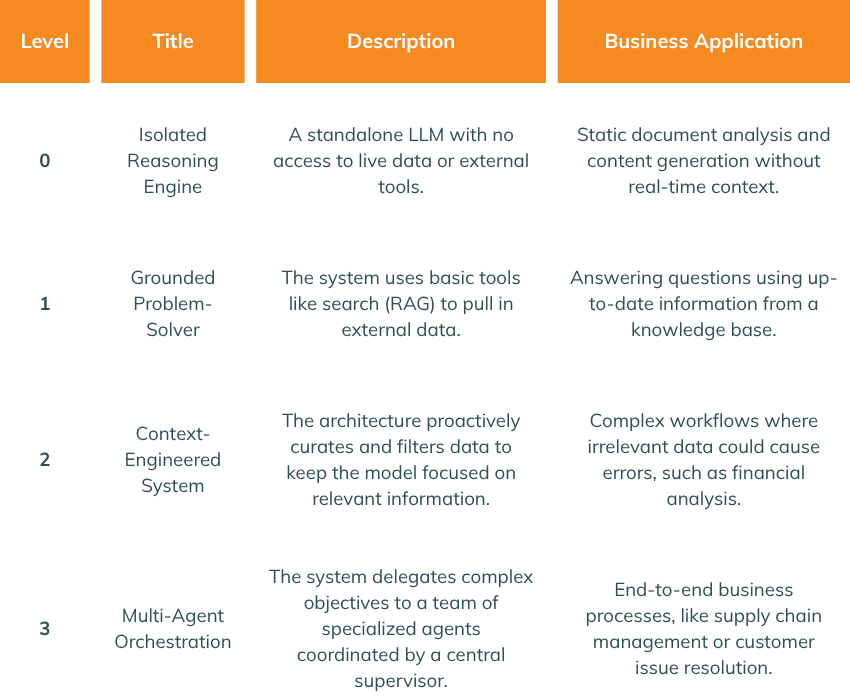
The Spectrum of Autonomy: 4 Levels of Enterprise AI Maturity
Deploying these systems effectively requires understanding their operational independence.
The Foundational Toolkit: 6 Core Agentic AI Design Patterns
Building predictable agentic systems means designing for reliability. These six patterns are the essential building blocks for creating robust, enterprise-grade AI solutions.
1. Prompt Chaining: For Reliable, Multi-Step Processes
Business Problem It Solves: Complex processes fail when handled by a single, massive request.
Architectural Solution: Breaks a workflow into a sequence of smaller, isolated sub-tasks. Validation gates between each step prevent errors from moving downstream.
In Practice: A loan application workflow where a credit check must be successfully validated before triggering the risk assessment, ensuring compliance and accuracy.
2. Routing: For Efficient Task Delegation
Business Problem It Solves: Not all tasks are equal; treating them the same way creates bottlenecks and degrades quality.
Architectural Solution: A classification layer directs each incoming task to the specialized sub-agent or system best equipped to handle it.
In Practice: An automated customer operations platform that instantly routes incoming requests to either billing support, technical support, or account management, reducing manual triage time to zero.
3. Parallelization: For Maximum Speed and Efficiency
Business Problem It Solves: Sequential execution creates unnecessary delays when tasks aren't dependent on each other.
Architectural Solution: Divide the tasks into independent sub-tasks that run concurrently, with a final step to aggregate the results.
In Practice: A vendor onboarding process where compliance verification, financial audits, and IT security reviews all run simultaneously, dramatically cutting down onboarding time.
4. Reflection: For Insisting on Accuracy and Quality
Business Problem It Solves: Raw AI outputs are rarely accurate or formatted correctly for production systems.
Architectural Solution: A "producer" agent creates the output, while a "critic" agent reviews it against a strict checklist for accuracy, formatting, and compliance, sending it back for revision if needed.
In Practice: An automated financial reporting tool where one agent drafts the report and a second validation agent checks every figure against ledger schemas before the document is finalized.
5. Tool Use (Function Calling): For Turning Language into Action
Business Problem It Solves: Business systems need deterministic actions (like database writes), not just text.
Architectural Solution: The agent outputs a structured JSON object that matches the exact API schema of an internal application, triggering a specific function.
In Practice: An internal HR assistant handles a leave request by outputting a direct transaction that updates the HR system, rather than just describing what should happen.
6. Autonomous Planning: For Navigating Ambiguity and Complexity
Business Problem It Solves: High-level, ambiguous goals have no predefined script to follow.
Architectural Solution: The agent decomposes the goal into micro-tasks, executes the first logical step, analyzes the outcome, and then revises the rest of the plan in real-time.
In Practice: An agent investigating a supply chain anomaly. Each piece of data it uncovers (e.g., a shipping delay) informs its next query (e.g., checking weather patterns or port capacity).
Conclusion: Your Architecture is Your AI Strategy
The future of enterprise AI does not lie in simply acquiring powerful models; rather, it lies in architecting intelligent systems that can execute complex real-world business processes. Leveraging these core agentic design patterns enables organizations to build a strategic advantage, moving beyond simple automation to create dynamic, resilient and truly autonomous operations.
Is your organization ready to move beyond the AI hype and build real-world, agentic solutions? Let’s talk.